


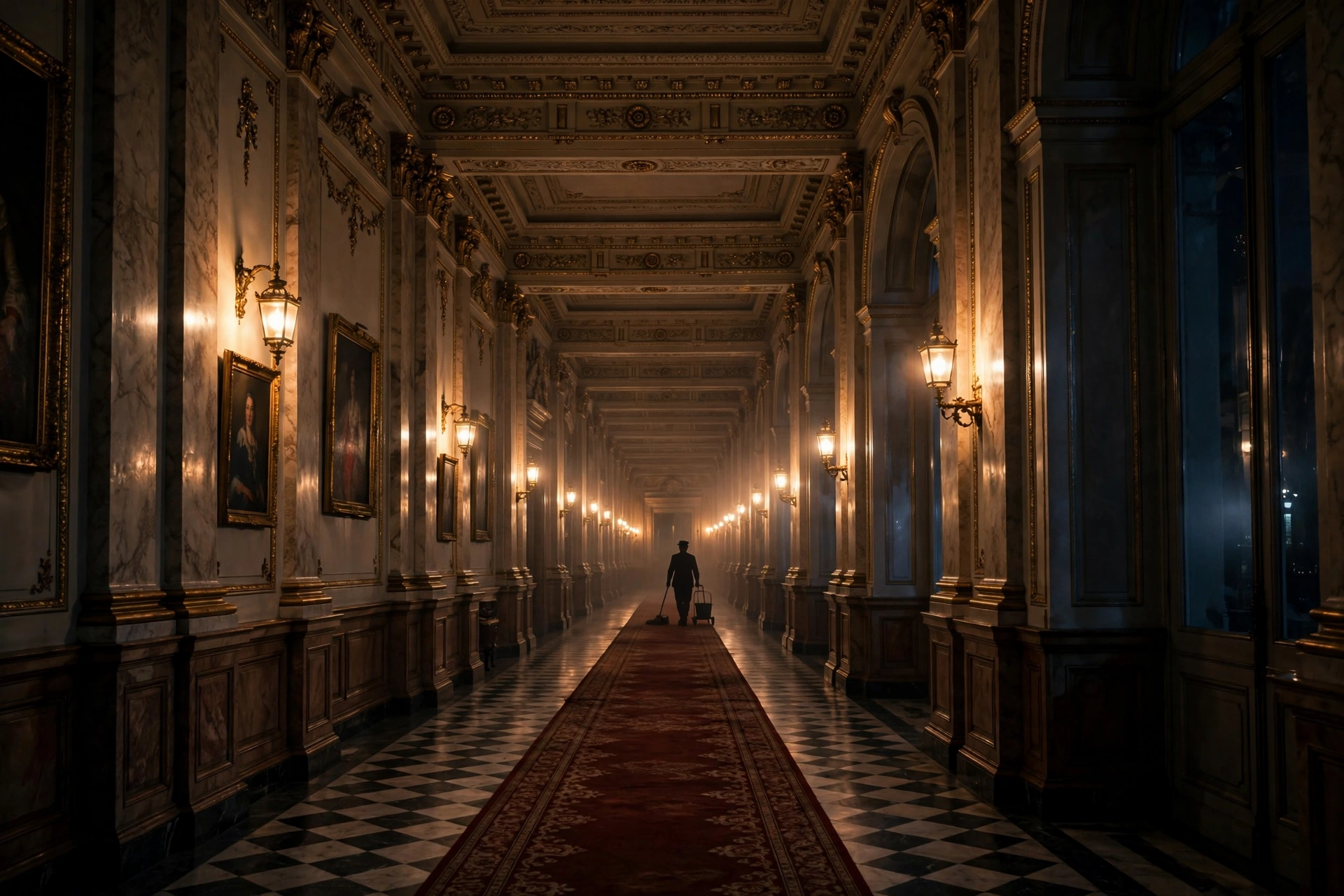
The last tour ends, the state rooms empty, and the palace lights dim to a conservation-approved glow. For most visitors, the story of a royal palace stops there. For a small, rarely discussed workforce, it is when the working day begins. The night staff of Britain’s great houses — wardens, conservators, security teams and cleaners — keep centuries of history intact in the hours nobody photographs.
A Working Night in a Sleeping Palace
The tasks are part housekeeping, part ritual. Conservation teams use the quiet hours to inspect tapestries and paintings in conditions visitors never allow: stable light, empty rooms, time. Dust is the eternal enemy of gilding and textile, and much specialist cleaning can only happen when a room is closed. Security patrols walk routes refined over decades, checking not only doors and alarms but the small anomalies — a window ajar, a drip where no drip should be — that matter enormously in buildings full of irreplaceable things. The organisation responsible for several London palaces, Historic Royal Palaces, maintains conservation and security operations that run around the clock for exactly these reasons.
Traditions That Outlive Their Reasons
Palace nights are thick with inherited routine. Ceremonies designed for a monarch’s safety centuries ago persist in adapted form: keys carried in procession, gates locked with a formality that long outlived the threats it answered. Keepers of these traditions argue they are not theatre but discipline — ritual is how an institution remembers to be careful. The Royal Family’s official site documents some of these ceremonies, though the night versions belong mostly to the people who perform them.
There is also the simpler human texture: night staff describe the buildings as different places after dark — quieter, more personal, almost borrowed. Several long-serving wardens have written memoirs about knowing a palace the way sailors know a ship. Our own archives cover the public face of these residences; the football-and-film noise of the modern royal news cycle rarely reaches the night corridors, which is perhaps why the people there stay for decades.
Why the Night Work Matters More Now
Climate pressure has made the invisible work urgent. Conservators monitor humidity and temperature through the night because a failed system at 3 a.m. can damage in hours what survived centuries. Fire remains the catastrophic scenario every palace plan is built around; the memory of the Windsor Castle fire of 1992 is institutional, retold to every new recruit. Night staff are, in the most literal sense, the insurance policy.
The Bottom Line
Palaces are presented to the world as perfectly still — rooms frozen in their grandest century. The stillness is an achievement, renewed nightly by people whose names appear in no guidebook. History, it turns out, is not kept by the buildings. It is kept by the staff who walk them in the dark.
